Attendee and exhibitor surveys are one of the clearest tools event leaders have to prove ROI. They gauge exhibitor and sponsor revenue, brand awareness, and event revenue. Yet 40% of organizers still struggle to prove event ROI, according to Bizzabo’s 2026 event benchmarks. Market research for events has changed considerably in the past three to five years. A flood of new survey tools offers more options than ever, and quantitative and qualitative methods can now be mixed, online or onsite.
Who conducts attendee and exhibitor surveys today?
Many event teams run surveys in-house with tools like SurveyMonkey or free Google Forms. Others bring in a research partner for objectivity, onsite staffing, or analysis time. Event Survey Group is one of those partners, conducting online and onsite attendee and exhibitor surveys that show what drives attendee satisfaction and exhibitor revenue.
The most common mistake, among event leaders and seasoned researchers alike, is reporting numbers without insight. When event leaders say, “the survey didn’t tell us anything,” it’s usually because no one budgeted time for analysis. When you budget time for a survey, plan for days or weeks of analysis, not hours. AI can speed this up by handling the first pass, with a human checking what matters.
What does an attendee survey look like today?
Event surveys no longer have to choose between quantitative and qualitative research. Quantitative design measures scale: how many attendees feel a certain way. Qualitative design explores the reasons and emotion behind a rating or behavior. Today the two easily live together, online or onsite.
For event leaders, this combination is often underused. The rating is a performance measure. The reasons attendees will or won’t return show how to improve next year’s event and how to market it to prospective attendees. Multiply the share of attendees likely to return by registration fees, and you have an early indicator of next year’s attendee revenue.
What does an onsite attendee survey involve?
A client asked whether it was possible to record attendee interviews onsite. Their objective was to probe deeper into attendee needs around session topics, networking, motivations to attend, and new cities to host future events. They wanted qualitative responses that dig into the causes underpinning event ROI. Tools that didn’t exist a decade ago can now meet that request.
First, we set objectives and designed a field guide with questions and follow-up probes. Timing came next. Attendees need a lived experience to report on, so we began interviews about three hours after the event opened on day two of a three-day event, once they’d been through networking and education sessions. Based on interview length and the event’s end time, we planned about 20 interviews with two survey administrators.
The event was one week out, so we had to deploy the intercepts rapidly. We sourced administrators through the Instawork gig platform. Event staffing agencies and traditional temp staffing weren’t an option given the timeline and a realistic budget.
We chose SurveyCTO for the interviews because it works online or offline and records voice. SurveyCTO includes AI transcription, but its output wasn’t in the format the client requested. To bridge the gap, Claude (AI) wrote a Google Colab script that sent the recordings from a Google Drive folder to Whisper for transcription. The client received the renamed audio files and an Excel file of all transcripts the same night.
The onsite survey captured attendees’ raw reactions in the moment. They didn’t pick from a list of answers, yet clear patterns emerged in what they said. The client heard first-hand, with all the tone of the moment, why attendees came, whether networking worked, what would be better, and what would draw them to a different city.
Can AI conduct attendee interviews online?
AI-moderated surveys are an emerging way to run a similar interview online, after the event. Outset, for example, conducts AI-moderated voice interviews. The core idea mirrors the onsite approach: set your objective, then write a field guide with follow-up questions that probe initial answers. The AI interviewer responds to each attendee in real time.
How do the survey options compare?
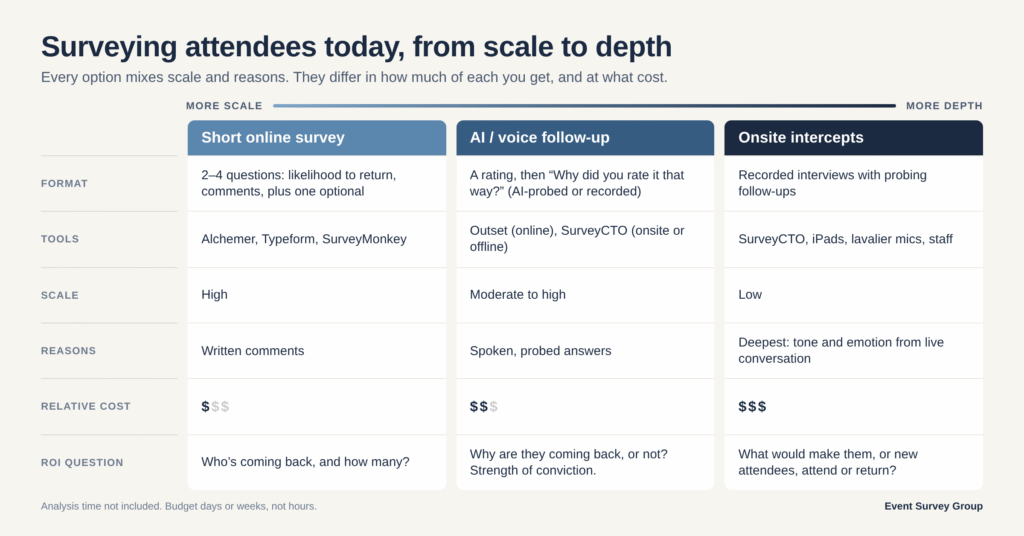
Every option below mixes scale and reasons, from fully automated to in-person. They differ in how much of each you get, and at what cost. The comparison excludes post-survey analysis time.
| Short online survey | AI / voice follow-up | Onsite intercepts | |
|---|---|---|---|
| Format | 2 to 4 questions: likelihood to return, comments, plus one optional. | A rating, then “Why did you rate it that way?” (AI-probed / recorded) | Recorded interviews with probing follow-ups. |
| Tools | Alchemer, Typeform, SurveyMonkey | Outset (online), SurveyCTO (onsite or offline) | SurveyCTO, iPads, lavalier mics, staff |
| Scale (quantitative) | High | Moderate to high | Low |
| Reasons (qualitative) | Written comments | Spoken, probed answers | Deepest: tone and emotion from live conversation. |
| Relative cost | Low | Moderate | High |
| ROI question it answers | Who’s coming back, and how many? | Why are they coming back, or not? Strength of conviction. | What would make them, or new attendees, attend or return? |
How does an exhibitor survey inform ROI?
Event Survey Group recently developed a procedure to assess event revenue at risk. It combines exhibitor spend, booth size, intent to return, and exhibitor history. The result shows where future event revenue is most at risk. The backbone is a post-event exhibitor survey conducted online. We used Alchemer, though Typeform or other tools are valid options.
The analysis answers a question every exhibit sales team asks: are our biggest names as secure as we think? In one recent project, the most secure exhibitor revenue, at low risk of leaving, came from one clearly defined segment. That let the team set that segment aside and focus on where the risk actually was.
The analysis also gives exhibitor sales a clear order for outreach, along with the right message for each group: exhibitors at highest risk, those still deciding on plans, and those whose revenue is secure.
Should event leaders conduct their own surveys?
The decision usually comes down to two questions. Does your team have time to write a questionnaire, choose a survey tool, run the survey, and complete the multi-day analysis that answers your critical questions? And would a third party reduce bias, both in how candidly attendees answer and in how results are reported?
If your team runs the survey but is short on analysis time, eventsurvey.ai turns a survey spreadsheet into a narrative report in minutes, with findings computed, not guessed. See a sample eventsurvey.ai report. For any finding that will drive a big decision, have someone with event expertise confirm it.
Whether you’d like to hand off the whole project, from questionnaire to recommendations, or just one piece of it, Event Survey Group can help. Use the Event Survey Group contact form to talk through which survey approach fits your event and your ROI goals.
